
As competition in the mattress industry continues to grow, manufacturers are increasingly investing in advanced machinery to improve productivity, product quality, and operational efficiency. One of the most important decisions a mattress factory faces is choosing between semi-automatic and fully automatic mattress machines.

Both options offer distinct advantages depending on production volume, labor availability, budget, and business goals. Understanding the differences can help manufacturers make the right investment and maximize long-term returns.
This article compares semi-automatic and fully automatic mattress machines to help mattress producers determine which solution best fits their factory needs.
Semi-automatic mattress machines require a combination of machine operation and manual labor during the production process.
Common semi-automatic equipment includes:
Operators are responsible for loading materials, positioning mattresses, or performing certain production steps manually.
Semi-automatic machines are generally more affordable than fully automatic systems, making them suitable for:
Most semi-automatic machines have simpler control systems and require less technical training.
Manufacturers can quickly adjust production settings for different mattress models and sizes.
With fewer automation components, maintenance is often simpler and less expensive.
Fully automatic mattress machines are designed to automate most production processes with minimal human intervention.
Examples include:
These machines integrate advanced controls, sensors, and automation technologies to maximize efficiency.
Fully automatic systems can operate continuously at high speeds, significantly increasing output.
Benefits include:
Automation minimizes manual operations and lowers labor dependency.
This is especially valuable in regions experiencing:
Automated systems reduce human error and ensure uniform production standards.
Benefits include:
Although the initial investment is higher, fully automatic systems often provide lower operating costs over time through:
| Factor | Semi-Automatic | Fully Automatic |
|---|---|---|
| Initial Investment | Lower | Higher |
| Labor Requirement | Higher | Lower |
| Production Capacity | Medium | High |
| Automation Level | Partial | Full |
| Maintenance Complexity | Lower | Higher |
| Product Consistency | Good | Excellent |
| Return on Investment | Faster Initial Payback | Higher Long-Term Efficiency |
| Suitable Factory Size | Small to Medium | Medium to Large |
For small and developing mattress manufacturers, semi-automatic machines often provide the best balance between cost and productivity.
Suitable situations include:
Semi-automatic equipment allows factories to enter the market with lower financial risk while maintaining production flexibility.
Large-scale mattress manufacturers typically benefit more from fully automatic solutions.
Ideal scenarios include:
Fully automatic systems help factories scale operations while maintaining consistent quality and reducing operational expenses.
Evaluate your daily and monthly mattress output requirements.
Higher production targets often justify greater automation.
Factories facing labor shortages may benefit significantly from fully automatic equipment.
Consider both initial investment and long-term operating costs when comparing options.
If production growth is expected, investing in automation may provide better scalability.
Factories producing a wide range of mattress models may require flexible machine configurations.
Many successful mattress manufacturers adopt a hybrid strategy by combining semi-automatic and fully automatic equipment.
For example:
This approach balances investment costs while improving overall production efficiency.
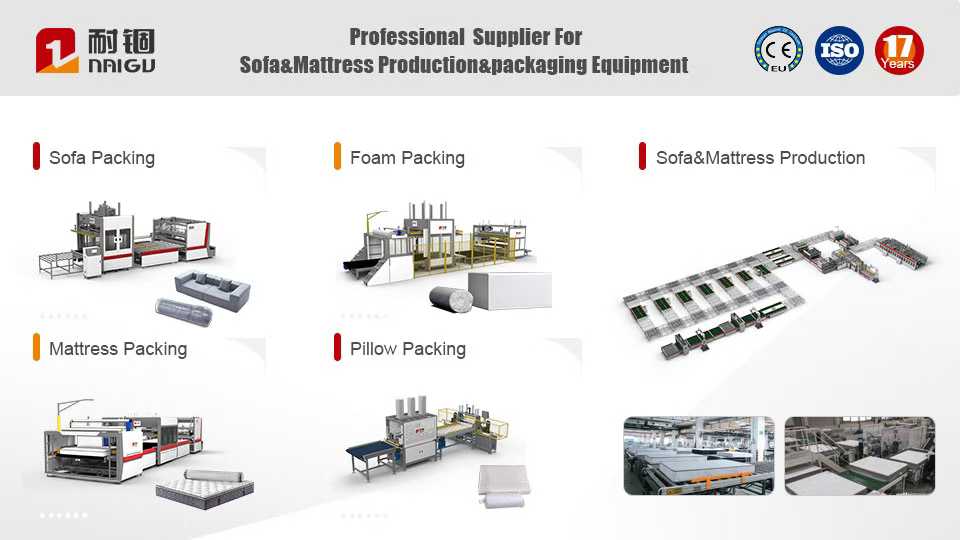
NAIGU provides both semi-automatic and fully automatic mattress manufacturing solutions, including:
Our team helps customers select the most suitable equipment based on factory size, production goals, and investment plans.
There is no one-size-fits-all solution when choosing between semi-automatic and fully automatic mattress machines. The best option depends on your factory’s production volume, labor situation, budget, and growth objectives.
Semi-automatic machines offer affordability and flexibility, while fully automatic systems deliver maximum efficiency, consistency, and scalability. By carefully evaluating your operational needs, you can select the right equipment to improve productivity and strengthen your competitiveness in the mattress manufacturing industry.
Looking for the right mattress production solution? Contact NAIGU today for professional advice on semi-automatic and fully automatic mattress machinery tailored to your factory requirements.
📧 Email: jenney@gdnaimei.com
📱 WhatsApp/Phone: +86 13924835577
🌐 Website: https://naigumattressmachine.com

