Categories
How to Expand Mattress Production Capacity Efficiently |NAIGU
Learn practical strategies to expand mattress production capacity efficiently through production line optimization, automation, improved packing processes, and better factory layout. Discover how the right mattress manufacturing and packing solutions can help increase output, reduce labor requirements, and support future factory growth.
Sep 2nd,2026
75 Views
As mattress demand continues to grow in both domestic and export markets, manufacturers are looking for practical ways to increase production capacity without significantly increasing labor costs or factory space. Expanding mattress production capacity is not simply about adding more workers or machines. A more effective approach is to optimize the entire manufacturing process, improve production flow, and introduce automation where it delivers the greatest impact.
1. Identify Production Bottlenecks First
Before investing in new equipment, mattress manufacturers should identify where production is slowing down.
Common bottlenecks can occur in:
-
Foam cutting and processing
-
Mattress assembly
-
Quilting and sewing
-
Tape edging
-
Compression
-
Packing and wrapping
-
Material handling
For example, if mattress production is completed faster than the packing department can process finished mattresses, adding capacity to earlier production stages may not improve overall output. Analyzing production time at each stage helps manufacturers determine where additional equipment or automation will have the greatest effect.
2. Upgrade to a More Efficient Mattress Production Line
A well-designed mattress production line can connect multiple manufacturing processes and reduce unnecessary movement between workstations.
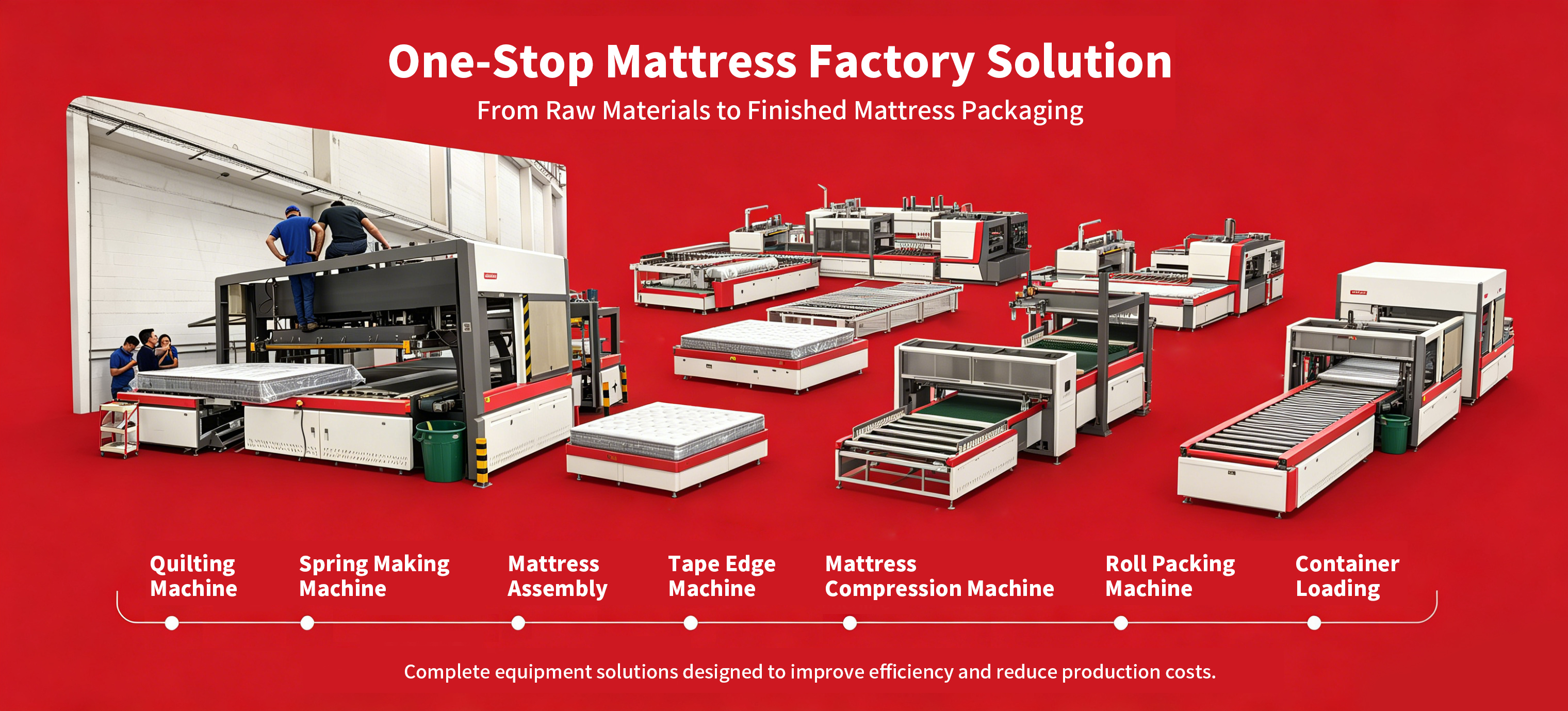
Depending on the factory's products and output requirements, a modern production setup may include:
-
Mattress quilting equipment
-
Foam processing machines
-
Mattress assembly equipment
-
Tape edge machines
-
Mattress compression equipment
-
Automatic mattress packing machines
Integrating equipment into a coordinated workflow can reduce handling time and make production more consistent. Manufacturers can also expand individual sections of the line as demand increases instead of replacing the entire system.
3. Automate Repetitive Production Processes
Automation is one of the most effective ways to increase mattress production capacity while maintaining consistent product quality.
Processes such as mattress compression, film wrapping, sealing, and conveying are particularly suitable for automation because they involve repetitive operations.
An automatic mattress packing machine can help manufacturers reduce manual handling and improve packing speed. For factories producing large quantities of mattresses every day, automated packing can also help balance production capacity between manufacturing and final packing.
4. Improve Mattress Compression and Packing Efficiency
Packing is an important part of production capacity that is sometimes overlooked.
Traditional mattress packing methods can require significant manual labor and floor space. Compression roll packing can reduce the volume of suitable mattresses before transportation and storage, while also improving the efficiency of the packing process.
A mattress compression roll packing machine can integrate compression, rolling, and packing processes into a streamlined operation. This can help manufacturers process more finished mattresses with less manual handling.
For export-oriented mattress factories, efficient compression packing can also provide additional benefits during storage and transportation by reducing the space required for packed mattresses.
5. Choose Equipment Based on Actual Production Requirements
Not every factory needs a fully automated production line. The right equipment depends on several factors, including:
-
Daily mattress output
-
Mattress dimensions
-
Mattress thickness
-
Mattress materials
-
Available factory space
-
Labor costs
-
Required automation level
-
Future production targets
A semi-automatic mattress packing machine may be suitable for a growing factory with moderate production volume, while a fully automatic solution may be more appropriate for large-scale manufacturers.
Selecting equipment according to actual production requirements helps avoid unnecessary investment while leaving room for future expansion.
6. Optimize Factory Layout
Increasing capacity does not always require expanding the factory building.
A better layout can improve material flow and reduce unnecessary transportation between production stages. Raw materials, semi-finished mattresses, finished products, and packing materials should move through the factory in a logical sequence.
Manufacturers should consider:
Material Storage → Production → Assembly → Compression/Packing → Finished Product Storage → Loading
Reducing unnecessary movement can save time and make better use of existing factory space.
7. Use Data to Monitor Production Performance
Production data can help mattress manufacturers identify opportunities for further improvement.
Important indicators include:
-
Units produced per hour
-
Machine utilization
-
Labor productivity
-
Packing speed
-
Downtime
-
Material consumption
-
Production rejection rate
By monitoring these indicators, manufacturers can determine whether a bottleneck is caused by equipment capacity, labor availability, material handling, or production scheduling.
Regular performance analysis also makes it easier to plan future equipment investments.
8. Plan Capacity Expansion for Future Demand
When expanding production capacity, manufacturers should consider not only current demand but also expected future growth.
For example, a factory currently producing 500 mattresses per day may eventually need to reach 800 or 1,000 units per day. Selecting modular equipment and scalable production solutions can make future expansion easier.
Instead of completely redesigning the factory later, manufacturers can reserve space and production capacity for additional equipment from the beginning.
Conclusion
Efficiently expanding mattress production capacity requires more than simply purchasing additional machines. Manufacturers should first identify production bottlenecks, optimize factory layout, automate repetitive processes, and improve mattress compression and packing efficiency.
A properly planned mattress production line can help factories increase output, reduce manual handling, improve workflow, and prepare for future market growth. For manufacturers looking to expand gradually, combining automation with scalable mattress packing solutions can provide a practical path toward higher production efficiency.
Looking for a mattress production line or mattress packing solution for your factory? Contact NAIGU to discuss your production capacity, mattress specifications, and automation requirements.


