
For mattress manufacturers, investing in an automatic mattress packing machine is not just about upgrading equipment—it’s a financial decision that directly affects profitability, labor structure, and long-term competitiveness.
While many buyers focus on the initial machine price, experienced factory owners care more about one key question:
How long does it take for the machine to pay for itself?
This article breaks down the ROI (Return on Investment) and payback cycle of automatic mattress packing machines using real factory scenarios.
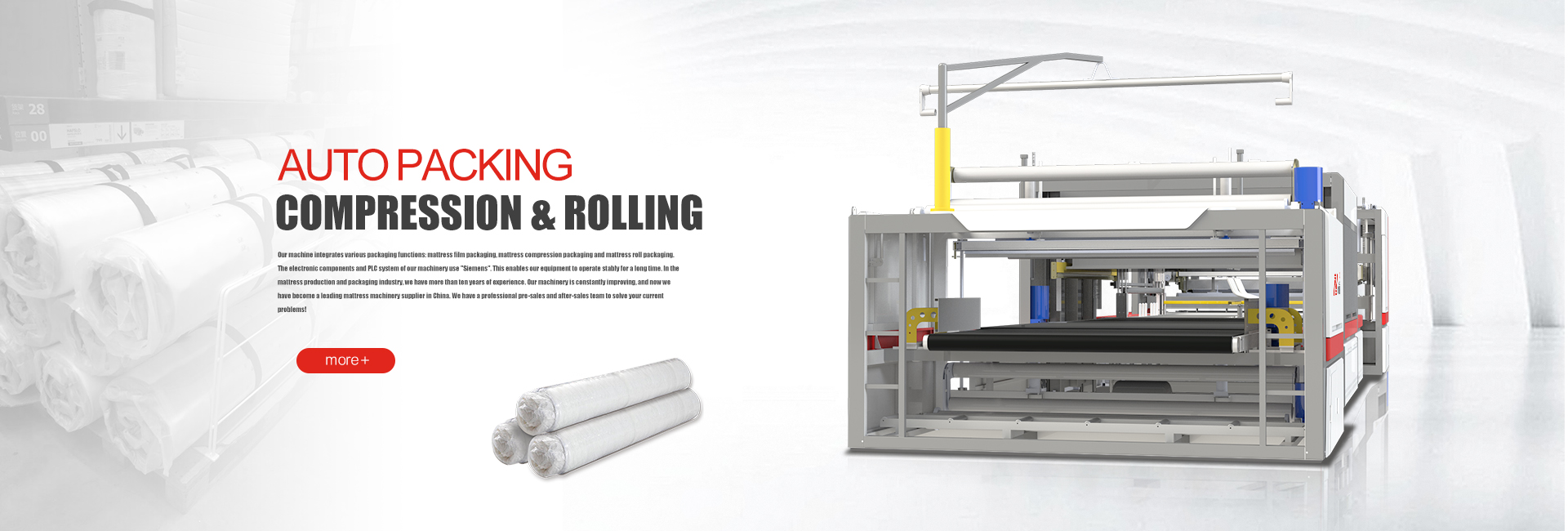
The payback cycle refers to the time required for cost savings and productivity gains to cover the initial investment of the machine.
In mattress packing automation, ROI typically comes from:
Reduced labor costs
Higher packing efficiency
Lower packing material waste
Reduced damage during transportation
Increased export packing capability
Manual or semi-automatic mattress packing often requires:
3–5 workers per shift
Heavy physical labor
Inconsistent packing quality
An automatic mattress compression and packing machine usually requires:
1 operator
Minimal manual handling
Typical labor savings:
✔ 2–4 workers per shift
✔ 20–40% reduction in packing labor cost
| Packing Method | Output (Mattresses / Hour) |
|---|---|
| Manual packing | 5–8 |
| Semi-automatic | 10–15 |
| Fully automatic | 25–40 |
Higher throughput means:
Faster order fulfillment
Less production bottleneck
Better on-time delivery performance
Automatic mattress compression packing:
Reduces mattress volume by 60–75%
Allows more mattresses per container
Lowers shipping cost per unit
For export-oriented factories, this alone can significantly shorten the ROI cycle.
Automatic systems offer:
Stable tension control
Accurate film usage
Consistent sealing
This results in:
Less film overuse
Fewer repacks
Lower long-term consumable costs
Daily output: 80–120 mattresses
Labor saved: 3 workers
Monthly labor savings: USD 1,200–1,800
Shipping savings: USD 800–1,200 / month
Estimated payback cycle:
👉 8–14 months
High container usage
Frequent long-distance shipping
Strict packing consistency requirements
Main ROI drivers:
Container optimization
Damage reduction
Faster packing speed
Estimated payback cycle:
👉 6–12 months
Instead of hiring more workers, automation allows:
Stable output increase
Controlled labor cost
Better scalability
Estimated payback cycle:
👉 12–18 months, with strong long-term margin improvement
The actual payback cycle depends on:
Daily mattress output
Local labor cost
Export ratio
Mattress size range
Level of automation (semi vs fully automatic)
Factories with higher labor costs and export volume achieve ROI faster.
Beyond direct cost savings, automatic mattress packing machines help manufacturers:
Standardize packing quality
Reduce dependency on skilled labor
Improve factory image for international buyers
Prepare for higher-volume contracts
Automation is no longer a luxury—it is becoming a baseline requirement in modern mattress manufacturing.
Looking to calculate the ROI for your own factory?
Contact NAIGU for a customized payback analysis based on your mattress size, output, and export needs.📧 Email: jenney@gdnaimei.com
📱 WhatsApp/Phone: +86 13924835577
🌐 Website: https://naigumattressmachine.com

