
For mattress manufacturers looking to expand into international markets, packaging is not just a final step—it's a critical part of the export strategy. Export-oriented mattress factories face unique challenges: high shipping costs, limited container space, and the risk of damage during long-distance transit.
This is where a mattress packing machine (specifically, a mattress compression and rolling machine) becomes an indispensable asset. In this guide, we explore why these machines are essential for exporters, how they work, and what features to look for when choosing one for your factory.
Exporting mattresses internationally is vastly different from domestic shipping. Standard mattresses are bulky and lightweight—inefficient for container transport.
The Challenge:
A standard 40ft HC container can hold only 40–50 unpacked mattresses.
Shipping costs are calculated by volume, not weight, making air or sea freight expensive.
The Solution:
A mattress compression and roll packing machine can reduce mattress volume by up to 80% . This means:
Up to 200–300 compressed mattresses can fit in a single container.
Significant savings on shipping costs.
Reduced carbon footprint per unit shipped.
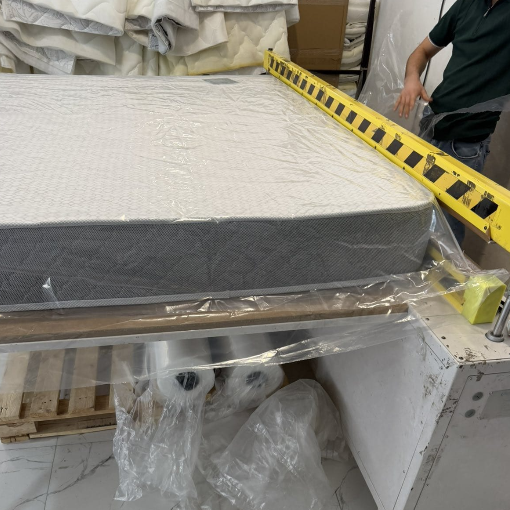
Export-oriented mattress packing machines typically use a compression and rolling process:
Loading: The mattress is placed on the machine's conveyor or loading platform.
Compression: Hydraulic or mechanical presses apply pressure to reduce the mattress thickness (often to 10–20% of original height).
Rolling: The compressed mattress is rolled into a compact cylinder.
Wrapping: A plastic film or bag is applied to maintain compression during transit.
Sealing: The ends are sealed to prevent air and moisture from re-entering.
Once the mattress reaches its destination and the packaging is removed, it slowly re-expands to its original shape without damage.
By compressing mattresses, exporters can fit 3–5 times more products per container. This directly translates to lower shipping costs per unit and higher profit margins.
Compressed and rolled mattresses are:
Less prone to shifting during transport.
Protected by multiple layers of plastic film.
Resistant to dust, moisture, and dirt.
Compressed mattresses take up less warehouse space, allowing factories to:
Store more finished goods.
Consolidate shipments more effectively.
Reduce storage costs.
While a mattress packing machine requires an upfront investment, the shipping cost savings often recover the investment within months for high-volume exporters.
Not all mattress packing machines are the same. Export-oriented factories typically choose between:
Best for: Small to medium-scale exporters.
Features: Manual loading and sealing, automatic compression and rolling.
Pros: Lower cost, easier to operate.
Cons: Slower output, more labor required.
Best for: Large-scale exporters with high volume.
Features: Automatic feeding, compression, rolling, and sealing.
Pros: High speed (up to 60–100 mattresses per hour), minimal labor.
Cons: Higher initial investment, requires more space.
Some manufacturers offer machines tailored to specific mattress types (e.g., pocket spring, memory foam, latex) or special packaging requirements.
When selecting a mattress packing machine for export, consider the following:
| Feature | Why It Matters |
|---|---|
| Compression Ratio | Higher compression (up to 90%) allows more mattresses per container. |
| Rolling Diameter | Smaller rolls fit better in containers and are easier to handle. |
| Film Type Compatibility | Should work with various films (PE, stretch film, etc.). |
| Sealing Quality | Strong seals prevent air and moisture from re-entering. |
| Speed (Output) | Match the machine's speed to your production capacity. |
| Automation Level | Choose based on labor availability and budget. |
| After-Sales Support | Critical for minimizing downtime in export operations. |
Export-oriented factories often make these mistakes when adopting mattress packing machines:
Choosing the wrong machine size for their mattress types.
Skipping operator training, leading to inconsistent quality.
Ignoring film quality, resulting in torn packages during transit.
Not testing the machine with their specific mattress models before purchase.
Before Compression:
A factory exported 500 mattresses per month.
Required 10 containers (50 mattresses per container).
Shipping cost: High per-unit expense.
After Compression:
Same 500 mattresses fit in just 2–3 containers.
Shipping cost reduced by 60–70% .
ROI achieved in less than 6 months.
The industry is evolving. Emerging trends include:
Eco-friendly films made from recyclable materials.
Smart machines with IoT connectivity for real-time monitoring.
Automated labeling systems integrated with packing lines.
Multi-size machines that handle various mattress dimensions without manual adjustment.
📧 Email: jenney@gdnaimei.com
📱 WhatsApp/Phone: +86 13924835577
🌐 Website: https://naigumattressmachine.com

